

White Paper: Beamblocks Architecture - Assembly-Ready RF for the New Space Era
White Paper: Beamblocks Architecture - Assembly-Ready RF for the New Space Era
Beamblocks Architecture: Assembly-Ready RF for the New Space Era
How Crane Building Blocks Solves the LEO Quality-Cost-Schedule Equation
Executive Summary 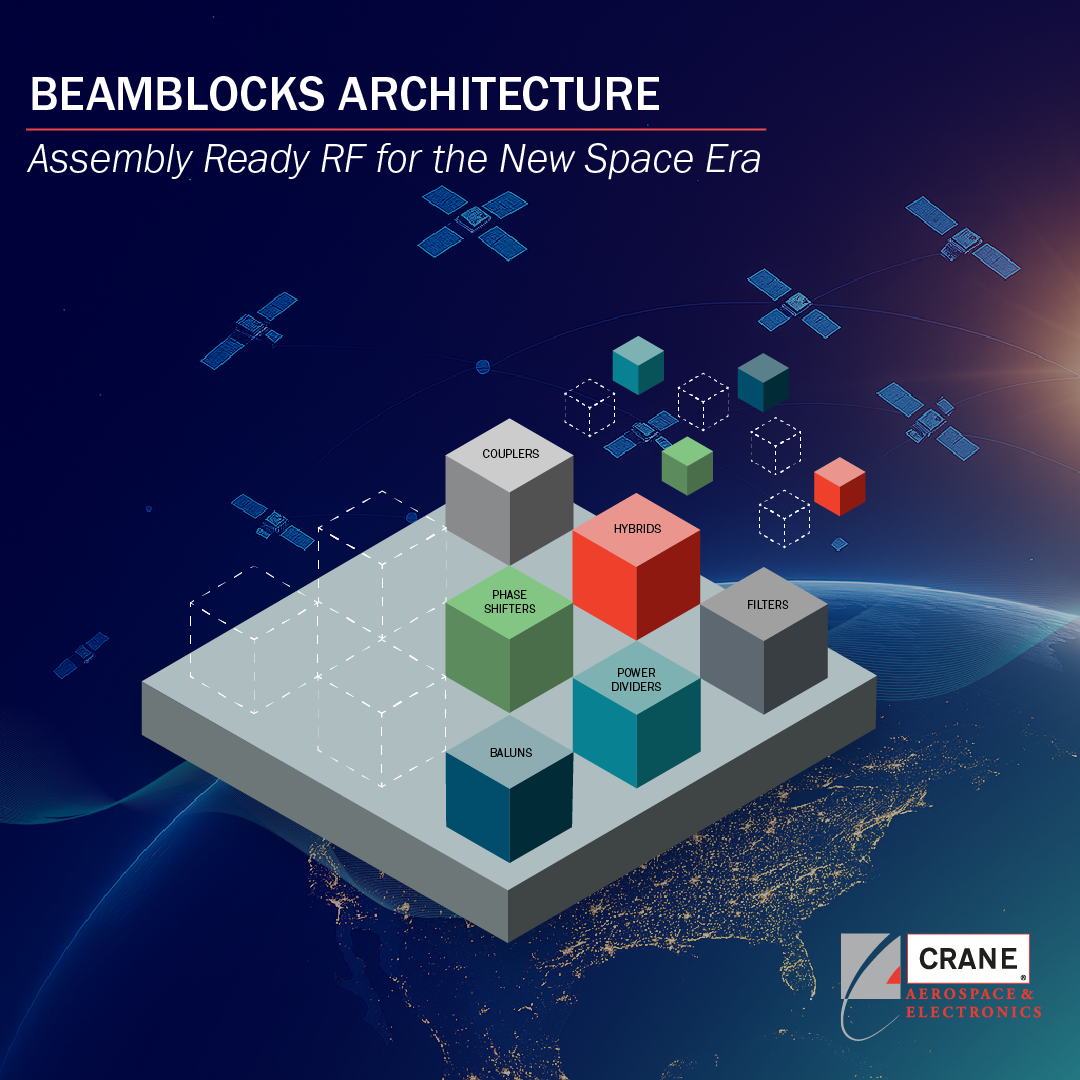
The satellite industry is undergoing a tectonic shift. The era dominated exclusively by "Class A" missions—characterized by 15-year lifespans and infinite budgets—is ceding ground to the dynamic velocity of Low Earth Orbit (LEO) constellations. Today’s programs demand hundreds of satellites, and with them, a new design paradigm.
Schedule and cost have become the governing physics of mission success. In response, Crane is introducing the Beamblocks Architecture—a modular, assembly ready approach to beamforming networks for space applications and ground support equipment. This approach leverages Crane’s more than three decades of experience delivering space‑qualified products. By leveraging our proven space‑qualified technology in Beamblocks Architecture alongside proprietary Multi‑Mix® fabrication, we provide a solution that moves beyond the custom‑tuning bottleneck.
Beamblocks provides a pathway to high-volume, cost-effective beamforming networks that deliver mission-ready performance—meeting the rigorous needs of LEO without the schedule and overhead of traditional Class A architectures.
1. The Industry Challenge - The "Class A" Trap for Decades
RF beamforming networks were treated as custom masterpieces—hand-tuned, individually machined, and expensive. While appropriate for a single GEO satellite intended to last two decades, this model is prohibitive for LEO constellations.
- The Cost Barrier: Traditional beamformers using customized machined housings, in low quantity, and requiring intensive tuning drive unit costs too high for constellations requiring thousands of nodes.
- The Schedule Bottleneck: "Class A" tuning requires skilled technicians to manually adjust performance. LEO production rates are hindered by extensive tuning time.
- The Performance Overshoot: LEO missions, with 3-5 year refresh cycles, do not need performance margins to compensate for degradation due to prolonged exposure in harsh space environment, 15 years and beyond. They need performance that is repeatable and sufficient for the link budget.
The industry needs a solution that is "reliable" in the best engineering sense, perfectly matched to the mission requirements, with zero wasted margin on unnecessary cost or schedule.
2. The Solution: The Beamblocks Architecture
Crane proposes a shift from "Custom Design" to "Custom Assembly." We call this our Beamblocks Architecture—a modular, Multi‑Mix®‑based approach that delivers best‑in‑class RF performance while enabling configurable beamforming networks built from a library of space‑qualified discrete RF blocks. This architecture replaces traditional custom monolithic beamforming networks with a flexible catalog of assembly‑ready RF building blocks, providing adaptability across frequency, mode, and antenna architectures. S-parameters for discrete building blocks are readily available for system simulation. This provides design engineers the ability to evaluate system performance and optimization at an early state of the design cycle, improving the degree of confidence for mission success.
Frequency Precision for the LEO Spectrum
Importantly, this modularity does not sacrifice frequency agility. The RF building block library is optimized for the specific bands driving the New Space economy:
- Ku-Band (12-18 GHz): High-density standard couplers and dividers for user-terminal links.
- Ka-Band (26-40 GHz): Miniature, low-loss phase shifters and combiners essential for high-throughput gateway links.
- V-Band & Q-Band (40-60 GHz+): Emerging millimeter wave building block designs that leverage the dimensional stability of Multi-Mix® to handle millimeter wavelengths without the need for micro-machined waveguide. By utilizing surface-mount design on a coplanar carrier board, we deliver a custom solution using a standard manufacturing approach.
3. The Enabler: Multi-Mix® Technology and Space HeritageThe reason this building block approach is so unique is the material science behind the Multi-Mix® Technology. Standard PCBs use "prepreg" adhesive layers that introduce inconsistent dielectric properties that degrade phase accuracy in high-frequency LEO applications. Crane’s proprietary process directly fuses the dielectric layers, creating a monolithic part with no distinct interface layers. This results in a homogenous dielectric throughout the RF component, enhancing phase accuracy, stability and impedance matching.
Already Qualified and Flying
Crucially, and in order to minimize risk, this is not experimental.
- Material Heritage: The Multi-Mix® material system is fully space-qualified and has a 20-year flight heritage.
- Thermal Stability: Qualified for operation from -85°C to +100°C, ensuring reliability during the rapid thermal cycling of LEO orbits.
- Process Standards: Manufactured to standards derived from MIL-STD-883 Level S and MIL-PRF-38534 Class K requirements, bridging the gap between commercial speed and military reliability. We are not offering a "cheap commercial part." We are offering a Space-Qualified Heritage part manufactured with commercial velocity.
4. Eliminating the "Tuning Tax"
In a traditional Class A approach, up to 40% of the production schedule is consumed by "The Tuning Tax"—skilled technicians manually tuning to align phase and amplitude. This is unscalable for LEO.
The Crane Promise: Precision by Design, Not by Technician
Because the Multi-Mix® process manufactures RF components by printing a panel array and fusion bonding prior to singulation, the performance is locked in.
- Phase Balance: Inherently matched due to material homogeneity.
- Amplitude Balance: Exact registration of buried layers eliminates the need for adjustment.
- High degree confidence of mission success.
By adopting the Beamblocks Architecture, LEO operators can realize a 30–50% reduction in total integration cost.
- Hardware Savings: 20% (panel array manufacturing of RF components).
- Labor Savings: 80% (elimination of manual tuning).
- Schedule Savings: 50%+ (move from months to weeks).
5. Conclusion: Your Mission, Delivered
Crane Aerospace & Electronics is not just a supplier of RF components; we are an architect of solutions. Through our Beamblocks Architecture—a library of space‑qualified RF building blocks—we provide the LEO market with a distinct competitive advantage: the ability to shape and optimize beamformer architectures early in the design cycle, without the penalties of custom manufacturing schedules. The result is high‑performance, cost-effective solutions that get you to orbit faster.
Crane Aerospace & Electronics: Performance where it counts. Speed where it matters.